 The United States Department of Energy “The mission of the Energy Department is to ensure America’s security and prosperity by addressing its energy, environmental and nuclear challenges through transformative science and technology solutions.” |
 The National Nuclear Security Administration “Established by Congress in 2000, NNSA is a semi-autonomous agency within the U.S. Department of Energy responsible for enhancing national security through the military application of nuclear science.” |
 Oak Ridge Institute of Science Education “Supporting DOE and other federal agencies’ missions to strengthen the nation’s science education and research initiatives.” |
| Special thanks to Jennifer Tyrell, STEM Workforce Development, ORISE. |
| 2026 Summer Program Video |
Our FANTASTIC 2026 Summer Interns! 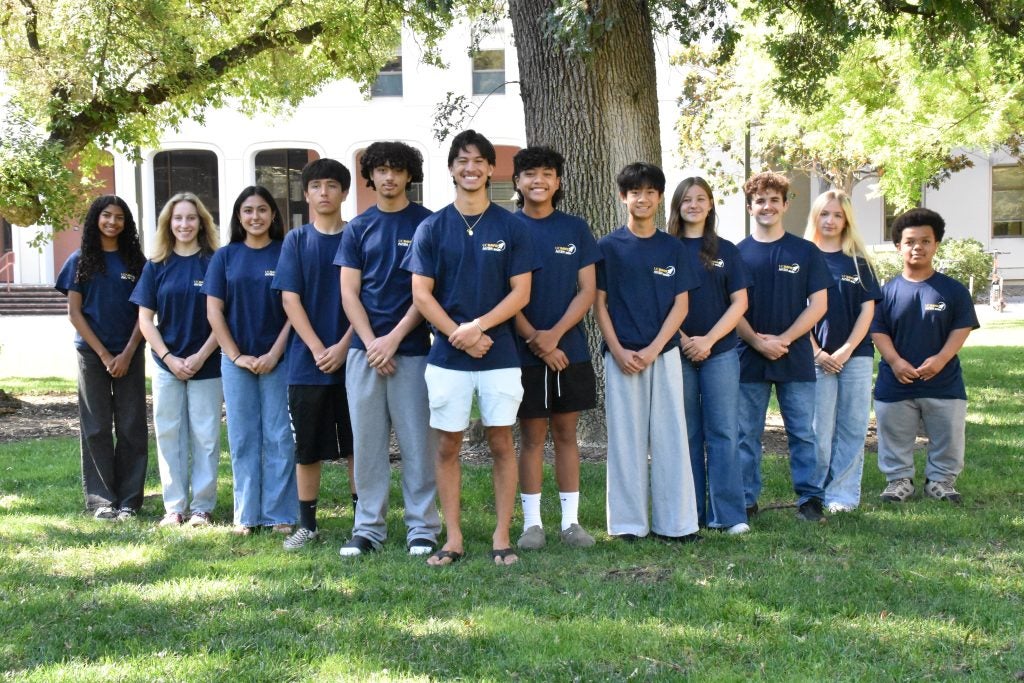 Left to Right: Maddie Goss, Emily Bely, Farah Osmani, Mario Ortiz, Nakoa Burr, Quinten Decker, Christian Palmos, Samuel Ching, Anna Yamaletdinova, Brayden Crouch, Olivia Southwick, Julien Tientcheu Our students come from River City High School in West Sacramento   |
Our instructors
|




| What we do- Part 1: We learn to code in python! We develope programs to study mathematics and physics. From approximating functions to plotting the molecular dynamics of springs, we built the skills to eventually predict the trajectories of our rockets. After launch, we compared our results with our python predictions and were able to visualize how each rocket flew and then analyze how air resistance played a role in our flight paths. Our computational lessons plans are available here: |
| What we do- Part 2: We build and fly rockets. This involves learning construction techniques, basic principles of rocket engines, etc. We then compare to codes which compute trajectories. This year we also simulated the mixing of the propellant, thanks to Tony Alcocer! Tony is the equipment manager at the Association of Experimental Rocketry of the Pacific (AERO-PAC). |
| What we do- Part 3: We build and fly drones. In previous years, we focused on drone construction, learning some electronics, computer interfacing, how to solder, mechanical construction, etc. but our drones remained hard to control. This year, we worked on our piloting skills with a drone obstacle course! |
| What we do- Part 4: Learning how electrical motors work. Our drones have 4 of them! We even test our hands-on skills and build an electrical motor ourselves, using a battery, a copper wire, and a magnet. |
| What we do- Part 5: Other Activities: UC Davis Lab tours, Liquid Nitrogen demos, superconductivity demos, Bohart Museum of Entomology. |
| Feedback from 2026 Summer Program Students & Parents Olivia Southwick: “The program was super fun and I got to learn a lot of new skills. I really enjoyed the lunches and the walk we did to get lunch: I’m glad I was chosen as one of the people to do this internship and I am very grateful for the experience.“
Andrea Southwick: “This was our first time experiencing any type of program like this and I didn’t know quite what to expect. I am so very grateful for the dedicated team that puts this program together and offers it to high school students. Being able to experience a college campus, high level instruction and many interactive projects was such a privilege. Olivia enjoyed being around peers and getting exposed to a subject that she otherwise would not have been inclined to spend any focused time on. The final day with the picture slide show as well as hearing the presentation of the students was wonderful! I was impressed and proud of all of the participants. Some of the students probably came in with zero knowledge or exposure to rocket science and coding, and after listening to their presentations it was evident that they all learned a lot. When I asked Olivia what her favorite part of the experience was, she said it was getting to be with the other students. In short, it was the people which is a credit to all of you who put the program together. I wish there were many more programs as dynamic as this one available in other subjects for students to experience. Thank you for extending the invitation to Olivia. I feel very blessed that she was able to participate in such an amazing program.“ Quinten Decker: “I had so much fun during the UC Davis internship. I was able to experience a professional work environment with my peers and enjoy learning about STEM topics. I learned to code and was even able to build and fly a rocket. I would recommend this to anyone and I had a lot of fun on this extremely unique adventure.“
Maddie Goss: “I liked the program I learned a lot of new things, and I got to meet different people I wouldn’t usually run into. And it was nice to be in a college setting and talk to professors.“
Farah Osmani: “I loved the program, the new things I’ve learned and also the people I made friends along the way was the best part of this program. Getting to know the professors on a personal level and having hands-on activities just made the experience a whole lot better. My parents were also impressed about the new things that I learned during the end of the program presentation. Learning how to code and getting to know how to make rockets made me feel more experience when it comes to engineering.“
Julien Tientcheu: “My parents and I think that this was a great opportunity for me to get exposure to college level work.“
Nakoa Burr: “My parents said that they thought it was a great program and that the presentations were a very nice end to it because they were able to understand what the students were doing during the 3 weeks.“
|
| Summer Program Alumni Where are they now and what are they doing? Updates from former students interns, several went on to major in STEM fields and accomplish great things. A few examples:
Adelina Armijo is a student in Mechatronics at Chico State. Her rocket construction/launch in the Spaceport America International Rocketry Competition in 2023, 2024 and 2025. Her team got their rocket to 10,500 feet.
Max Wright got his BS in Physics from UCD in 2026. He has already co-authored several research articles as an undergraduate researcher. He also served as an instructor for several editions of this program.
Jordan Criswell: Engineering degree in Robotics & Mechatronics from the University of Detroit, she is currently working as a Systems Engineer at GM.
Bryce Lu: Mechanical Engineering student at UCD and is currently in his junior year.
Alisha Vikash: Chemical Engineering Degree from UCD, she is currently working as a Risk Associate & Accounts Engineer.
Statements from former students & parents:
Bryce Lu participated in the program in 2021 “The UC Davis summer program had a huge impact on my academic direction. Before the program, I was a freshman who had to take all my classes online, and I had no idea what I wanted to do in life. During the summer program, I was able to figure out my interests through activities like working with drones and rockets. That experience made me very confident that I wanted to continue learning in these areas during and after high school. The program also gave me an early perspective on college life, which helped a lot when it came to my college decisions. Overall, the program helped me discover my interests and motivated me to become more involved in STEM.“
Adelina Armijo participated in the program in 2022 “The UC Davis summer program helped me in several ways. Learning Rocketry sparked my passion and that’s something that I have continued to work on throughout my college experience. I joined the UC Chico Rocketry club and was the vice president and treasurer for two years. I have also been doing research related to Rocketry for the past three years. I’m currently having three authored publications and working towards the first paper of which I’m the lead author. The summer program has given me a connection to UC Davis allowing me to apply to special programs in NASA. The summer program really equipped me to be able to have a very successful college experience and participate in several international rocketry tournaments.“
Alisha Vikash participated in the program in 2018 “During a summer internship program I used Python to code visual simulations showing how magnets behaved under different conditions. That experience taught me how to break down complex physical systems, test variables, and clearly communicate technical behavior. Those same skills now show up in my work as a Risk Associate & Account Engineer when I evaluate how systems respond to different operating and loss scenarios. Additionally, learning Python at an early age made me more comfortable with technical tools and structured problem-solving, which later supported my engineering coursework and field risk engineering work.“
|